Dr. Spivey
One Flew Over the Cuckoo's NestDr. Spivey is the ward physician whose position carries clinical responsibility but little independent power over the institution’s daily order. His relations with Nurse Ratched and Randle Patrick McMurphy show him caught between accommodation and action: he can help advance proposals that might improve ward life, yet his authority remains vulnerable to the hierarchy he serves.
Identity and Place in the Ward
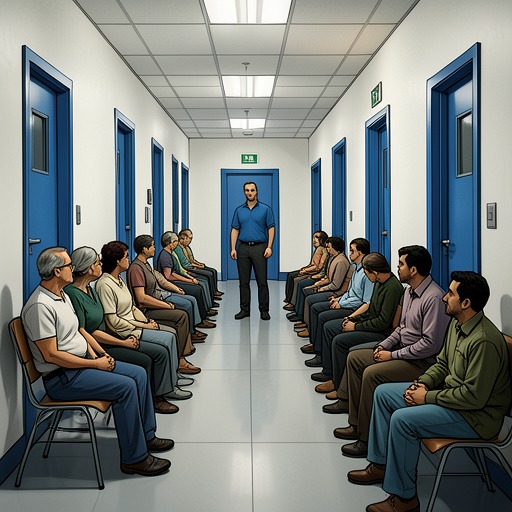
When Nurse Ratched introduces Randle Patrick McMurphy at a group meeting, she presents his folder to Dr. Spivey as the record of a new admission requiring his assessment. Dr. Spivey studies the file with his glasses, which hang from a string, and responds to McMurphy’s brash manner with evident amusement. He is careful, however, not to let that amusement become open laughter. The moment establishes a contrast between his personal reaction and the restraint expected of him in the ward’s formal setting.
Dr. Spivey is not simply an observer of ward policy. He explains the Therapeutic Community and its rule that patients remain seated during meetings, describing order as a condition for the group’s work. Yet the scene also shows Nurse Ratched setting the immediate agenda: she raises the seating rule, and Dr. Spivey begins to explain it. His professional role gives him a voice in the room, but not sole control over what the room discusses or how its rules are enforced.
A Physician with Limited Authority
Dale Harding describes the imbalance behind Dr. Spivey’s position. According to Harding, the doctor cannot hire or fire ward staff; that authority belongs to a supervisor who is Nurse Ratched’s longtime friend and former Army nursing colleague. Harding further argues that Nurse Ratched can threaten the doctor by reporting what she might characterize as excessive Demerol requisitions. This is presented as Harding’s account of the ward’s power structure, not as evidence that Dr. Spivey is addicted to the drug or that such a report has actually been made.
The account helps explain why Dr. Spivey is described as conscious of his inadequacy and unable to run the ward without Nurse Ratched’s help. Her ability to scrutinize his paperwork and charting makes ordinary administrative mistakes a source of leverage. The physician’s dependence is therefore institutional as well as personal: he may hold the title of doctor, but decisions about staff authority and the consequences of his work lie beyond his control.
That vulnerability is visible in smaller gestures. At a staff meeting called to discuss McMurphy, Dr. Spivey starts the proceedings while Nurse Ratched sits in silence. He checks and winds his watch, tries not to look at her, and appears nervous as he addresses the residents. His effort to begin the meeting is real, but the tension around his opening makes clear that he is acting under her gaze rather than presiding with unchallenged confidence.
Cooperation with McMurphy
Dr. Spivey’s relationship with McMurphy is not limited to clinical interviews. On McMurphy’s second day, the doctor asks to speak with him in his office, in keeping with his practice of interviewing new admissions on that day. The conversation becomes the basis for a later joint intervention in ward business. At a group meeting, Dr. Spivey interrupts Nurse Ratched’s effort to resume discussion of Dale Harding and announces that he and McMurphy have something in common: they attended the same high school.
The shared history gives him a credible way to redirect the meeting. Dr. Spivey recalls that he chaired the school carnival in both his junior and senior years, describing it as a noisy, decorated event with games and booths. He uses the memory to introduce a proposal for a ward carnival. The shift is significant not because it resolves the ward’s larger conflicts, but because the doctor helps move the group away from a session organized around a patient’s problems and toward a collective activity.
He also works with McMurphy on a practical proposal concerning the radio. Dr. Spivey frames the idea as a response to the mixed population of young and older patients: some older patients have difficulty hearing, so turning up the speaker might make the radio more accessible to them. He calls the suggestion humane and presents it to the group as the result of his conversation with McMurphy. His participation lends the proposal professional standing, while McMurphy’s observation supplies its impetus.
This cooperation gives Dr. Spivey a measure of initiative, but it does not make him master of the outcome. When McMurphy’s vote to change ward policy is ruled defeated because only twenty of the ward’s forty patients voted, Nurse Ratched closes the vote on the grounds that a majority is required. Dr. Spivey does not overturn that ruling. His proposals can enter the room and shape discussion, but the rules governing whether patients can turn discussion into policy remain in Nurse Ratched’s hands.
Clinical Encounters and Institutional Procedure
Dr. Spivey’s role also brings him into the ward’s disciplinary and treatment procedures. When McMurphy asks why patients are sent to the Shock Shop, the explanation is given in the context of the institution’s threat of escalation: patients deemed assaultive may be sent to the Disturbed Ward, where access to ordinary activities is restricted, and continued hostility can lead to shock treatment. The available scenes emphasize that the doctor works within a system in which treatment and discipline are closely entangled; they do not establish that he independently chooses every measure used against patients.
After McMurphy receives shock treatments, Dr. Spivey repeatedly appears with Nurse Ratched as McMurphy begins to recover. They ask whether he is ready to face his problem and return to the ward for a cure. McMurphy refuses, answering with defiance, and Nurse Ratched then leads the doctor to authorize another treatment by phone. Dr. Spivey is thus present at the point where the clinical language of recovery meets a process that continues despite McMurphy’s refusal. The sequence complicates his earlier willingness to collaborate with McMurphy: professional involvement does not amount to protection from the ward’s coercive procedures.
Character and Narrative Significance
Dr. Spivey’s defining tension is the gap between the authority associated with his profession and the restricted authority he actually exercises. He can explain the ward’s therapeutic principles, conduct interviews, and help turn McMurphy’s ideas into proposals. He can also appear uneasy under Nurse Ratched’s scrutiny and participate in treatment procedures that McMurphy resists. These actions make him neither an uncomplicated ally nor a simple counterpart to the nurse; they show a physician navigating a hierarchy that limits what his position can accomplish.
His brief alliance with McMurphy matters because it exposes a possible alternative use of his office. The doctor’s memories of the high-school carnival and his attention to older patients’ difficulty hearing the radio allow him to support proposals organized around shared activity and access, rather than only the correction of individual patients. But the failed vote and the repeated authorization of shock treatments mark the limits of that opening. Dr. Spivey can help introduce another possibility for ward life without being able to secure it against the institution’s established power.